
The recent “Building Community Connections” report from PressReader and Library Journal highlights a growing need for multilingual content in U.S. public libraries.
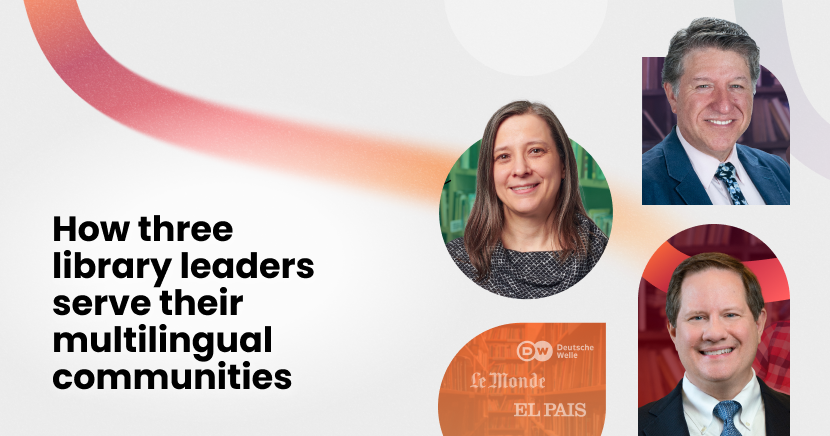
To explore the findings further, we brought together three leading librarians to discuss how they identify world languages in their communities and provide resources that meet every patron’s needs. Here’s what we learned.
Identifying community languages, then finding suitable materials, is an ongoing project
As Director at San Diego County Library, Migell Acosta is accustomed to serving linguistically diverse patrons. Citing the latest census data, he notes that 37% of people in San Diego County speak a language other than English at home. Going one step further, he and his team identified 11 “threshold languages" (languages spoken by at least 5,000 households) in the community.
“There is, in the United Nations, a program to resettle refugees,” adds Acosta. “San Diego County accepts the higher proportion, percentage-wise, than pretty much any other county in the United States. So, we have very thriving refugee resettled communities here, and so we want to support their language needs.”
That means continuously updating the content and services the library provides. As highlighted in the Building Community Connections report, eight in ten U.S. public libraries have recorded an increase in membership diversity over the last decade or two, and San Diego County is no exception. But securing diverse content for the collection can be a challenge.
Acosta cites that 61% of the non-English languages spoken in his region’s communities are Spanish dialects. One way that his library looks to source Spanish-language materials is to attend international events and fairs (the librarians cover another solution that requires much less travel a little later.)
“Our staff every year, partially supported [by] the American Library Association, go and attend the Guadalajara Book Fair to get Spanish language materials,” says Acosta (perhaps they even crossed paths with the PressReader team who also attended this year’s event!)
The demand for diverse materials is rising for multiple reasons

Acosta notes that non-English content is also in high demand among English-speaking patrons. “We had a Spanish language story time,” he recalls. “Most of the participants were English speaking, but they wanted their children to start learning another language. So, there’s that aspect as well.”
Then there are patrons who want to consume English-language content, but in a language that’s more comfortable and familiar for them. Acosta learned from his staff that the most popular materials include English-language bestsellers that had been translated.
This was also a trend noted by Andrew Medlar, President and Director at Carnegie Library of Pittsburgh (CLP). His team serves a city of 300,000 people in a county of 1.2 million. “It’s a city where 10% of folks speak more than one language,” he notes.
“So, our primary languages in which we collect, beyond English, are Spanish and Russian and Chinese,” he adds. “We actively collect also in Ukrainian, Japanese, Korean, Arabic, Italian, French, and German content — and again, look to serve our neighbors in those languages across our core services.”
Communities evolve, but diversity is nothing new
Medlar notes that the local demography shifts and changes much more quickly than the census reports do. For example, his team has noticed many new community members from Nepal recently. So, delivering the right materials in the right languages is always a work in progress.
Yet while language diversity may be in constant flux, Katie Anderson, Collections and Online Resources Librarian at Washington County Library Cooperative Services (WCLCS), points out that multilingual communities have always been the norm in the U.S.
“In my region, Indigenous Languages, Chinese, Japanese and Spanish have been spoken here for over a century, longer than my ancestors have been in the country,” she says.
Located in Washington, Oregon, WCLCS consists of 13 independent libraries. And while it has a few main threshold or “safe harbor” languages which primarily include Spanish and Chinese, Anderson acknowledges that her patrons speak more than 90 different languages at home.
“It’s not new, and it’s not a problem,” affirms Anderson. “It’s just something that we are now starting to figure out how to address, and it’s slow and challenging.” One way to tackle this challenge? “Working with vendors that share a common value around [the fact] that this isn’t a problem, it’s how people live,” she says.
Providing diverse materials while operating on a budget is possible
As noted in the Building Community Connection report, the lack of linguistically diverse resources in U.S. public libraries is not due to indifference or oversight on the part of the staff, and Acosta corroborates this. “The gaps reported have more to do with budget and business practices than any intentional disregard,” he says.
Medlar agrees. “One of the challenges of doing this work is the budget and slicing that pie across and amongst all of these needs. And so when there is a service or a product that, for one subscription, can provide access to materials — even if it's a smaller amount of readers who want to engage in them — that's something that is a really big help to us, and helps us meet that goal of serving everybody.”
This is a big reason why public librarians, and their patrons, find such value in digital resources like PressReader. “Being able to provide a wide variety of materials is really something that PressReader enables us to do in a way that other services and products don’t,” says Medlar.
“Our main library is right between the University of Pittsburgh and Carnegie Mellon University, so we have many, many international students and international faculty who come from all over the world. And being able to provide materials in languages that are comfortable and familiar to them, and that they choose to consume content in, is really important.”
Not only does PressReader provide translations of English-language materials, which is something that both Medlar and Acosta noted as being a major priority for their patrons, but it also includes foreign language publications from more than 120 countries to engage audiences from all over the world.
“Hats off to PressReader,” says Acosta. “The ability to provide our customers their country of origin’s newspapers in their language — in their original language — is huge.”
When a service delivers real value, word spreads. “We are very lucky that we have a lot of Spanish-speaking staff at all of our member libraries, from many different countries of origin,” says Anderson. “They very quickly became the champions of PressReader, and use it themselves and talk about it with their friends and family.”
These are just some of the challenges and solutions that the panelists discussed. For more insights from these three library leaders, watch the full webinar here.
And download the Building Community Connections report for a closer look at language diversity trends across U.S. public libraries, and how you can meet the ever-evolving needs of your patrons and community.